by Jack Craib, New Rep Reviewer
To call New Rep’s current production “The World Goes Round” a nearly perfect summer evening’s entertainment would be an understatement. It’s a show for all seasons regardless of temperature, but this show is hot. Twenty years ago, this compilation of songs by composer John Kander and the late lyricist Fred Ebb was created, with input by Kander and Ebb themselves, by librettist David Thompson, director Scott Ellis, and choreographer Susan Stroman. The genius of their collaboration lies in the fact that, unlike other “and then I wrote” shows, this consists not of a string of tenuously related show tunes, but a carefully constructed series of vignettes, each song or medley managing to convey a more or less complete story or mood. The show survives as a tribute to the first twenty-nine years of the body of work by Kander and Ebb. Thus there are no echoes from their later works; there is no “Steel Pier”, no “Curtains”, and especially no “Scottsboro Boys”. There are twenty-nine numbers from their extraordinary output for Broadway, films, television and even an industrial show, running the gamut from mega-hits like “Chicago” and “Cabaret” to the lesser-known “Zorba”, “The Rink” and “The Happy Time”. Above all, this show illustrates how these two men, throughout their careers, emphasized the downtrodden and the unsung….until they made them soar in song, the truth of their characters always flowing.
Kander and Ebb, like many of their contemporaries, wrote primarily for women who need no surname introduction (Barbra, Chita, Gwen, and most frequently, Liza), so it shouldn’t be a surprise that the women in this company, all familiar to New Rep audiences from previous appearances, have the best opportunities to shine. And shine they do, but often in surprising ways. Leigh Barrett confirms her status as a true Broadway belter, but she also gets the chance, in such numbers as “My Coloring Book” (the first song the team ever wrote), to create several very moving quiet moments. Shannon Lee Jones, remembered for her contribution to New Rep’s previous production of “Cabaret”, while exhibiting solid talent in songs like “A Quiet Thing” (from Liza’s first show, “Flora the Red Menace”) exceeds expectations as a comedienne in another Minnelli number, “Arthur in the Afternoon”. The most pleasant shock, given her prior serious roles at New Rep, is the comic artistry of Aimee Doherty, who equals the comedy chops of Leigh Barrett in their duets of “Class”, unforgivably dropped from the filmed version of “Chicago”, and “The Grass Is Always Greener” from “Woman of the Year”. The latter song is a good example of how a number can alter its meaning when not heard in the original context of its source but still be hilarious.
The men in the company have a tougher time. The title song from “Kiss of the Spider Woman”, sung by De’Lon Grant, is meaningless out of context (and, curiously, was included in the 1991 original “And the World Goes ‘Round” even though it was to be another year before “Spider Woman” opened in London and two years before its opening on Broadway), as is the number “Marry Me”, sung by David Costa, who at least gets to sing the unforgettable “Mr. Cellophane” from “Chicago” and the haunting “Sometimes a Day Goes By“ from “Woman of the Year“. The other men in the company who provide the music for the magic are Musical Director Todd C. Gordon on electronic keyboard (sadly, not a piano), Brian Grochowski on bass, and Jim DeLorey on percussion (and kazoo). There is a fourth excellent woodwind musician who is uncredited in the program. The technical contributions by Erik D. Diaz (scenic design), Deidre McCabe Gerrard (costume design) and Deb Sullivan (lighting design) are all first-rate.
When all is said and done, however, the success of this production rests squarely on the shoulders of Director and Choreographer Ilyse Robbins (with an occasional homage to Bob Fosse). Without her consistently fluid overall approach, as well as her countless amazing little touches, this could easily have been a flat and dispassionate bunching of disjointed star turns. It’s hard to believe that this is only her second professional directing effort, much less that, according to the background information from New Rep‘s website, she accomplished this with just two weeks of rehearsal. Thanks to her vision and the talents of this impressive cast, the sweat never shows, but the heat sure as hell does.

Wednesday, July 13, 2011


Review of the Revue
You know those shows that just make you happy? This is one of those shows.
For their 2011 Summer Show, New Rep has collected a startlingly talented group of performers, and given them a long list of some of the catchiest songs you've ever heard. At intermission, we heard milling audience members humming the tunes in the lobby, at the snack bar, and even in the bathroom!
If you're looking for plot, or deep emotional upheaval, this ain't it. But if you want a fun, frisky night out, you couldn't do better than the award-winning musical revue of Kander & Ebb tunes, "The World Goes 'Round," done with classic New Rep panache.
The cast features several New Rep favorites, including the talented and versatile Leigh Barrett and Aimee Doherty. Barrett and Doherty's duet of "Class," from "Chicago," is a comedic highlight of the show. Shannon Lee Jones rounds out the production with a jazzy, breezy Broadway style (and how did she fit into that stunning black jumper at the end of Act 1?). Two terrific male performers complete the set, both of whom have graced New Rep stages before. De'Lon Grant, recently seen in "Passing Strange," is funny and poignant by turns, and demonstrates some astonishing upper body strength in "Arthur in the Afternoon." David Costa shows off some fancy dance moves throughout, especially shining in "Sara Lee."
The cast rarely all congregate; rather, this show is a venue for each performer to shine, mostly individually, although the duets and overlapped songs were some of my favorite parts. The format also showcases acting as well as singing talent; each song creates a character, and a particular situation, that the actors make immediately apparent. If there was a weak link in the cast, we couldn't spot it.
Ditto for the production values; direction, music, choreography, lighting, set, props, and costumes all worked together beautifully. Three cheers also for the band, who are playing almost continuously, without missing a beat. We especially appreciated the flautist, whose name unfortunately does not appear in the program, but whose talents were much in demand in nearly every song. Kander and Ebb apparently appreciated woodwind emphasis to evoke all kinds of moods.
While we've long loved their shows, we knew little about these composers before last night. We're grateful to New Rep for showcasing their collective creative genius in a show that left a smile on the face of everyone there. Great fun!
~ Shauna Shames & Johanna Ettin
Wednesday, June 29, 2011
First Rehearsal for The World Goes 'Round
Yesterday morning, New Rep Subscribers, donors, observers and staff gathered at the Arsenal Center for the Arts for The World Goes 'Round's first rehearsal. Viewers were greeted by the New Rep family, a warm and welcoming group of performers, designers and directors, and many laughed when invited to taste the assortment of Sara Lee desserts--an homage to Kander & Ebb's song "Sara Lee."
Though brisk in nature, the one-hour Meet & Greet served as an opportunity for both cast and viewers to better understand the direction of the musical. Director and choreographer Ilyse Robbins explained her vision to the crowd, supported by the artistic visions of set designer Erik Diaz, costume designer Deirdre McCabe Gerrard, props designer Joe Stallone, lighting designer Deb Sullivan and music director Todd C. Gordon. After the formalities had finished, it was time to jump into rehearsal--all ten hours of it! Stay tuned for more photos soon...
Though brisk in nature, the one-hour Meet & Greet served as an opportunity for both cast and viewers to better understand the direction of the musical. Director and choreographer Ilyse Robbins explained her vision to the crowd, supported by the artistic visions of set designer Erik Diaz, costume designer Deirdre McCabe Gerrard, props designer Joe Stallone, lighting designer Deb Sullivan and music director Todd C. Gordon. After the formalities had finished, it was time to jump into rehearsal--all ten hours of it! Stay tuned for more photos soon...
 | |
| Ilyse Robbins, director and choreographer, explains her views on the play to the cast and observers. l. to r. Ilyse Robbins, David Costa, Leigh Barrett, and Erik Diaz. |
 | |
| With a day full of singing and dancing ahead, it's good to have a coffee break! |
 |
| What better way to kick off The World Goes 'Round than with a globe... |
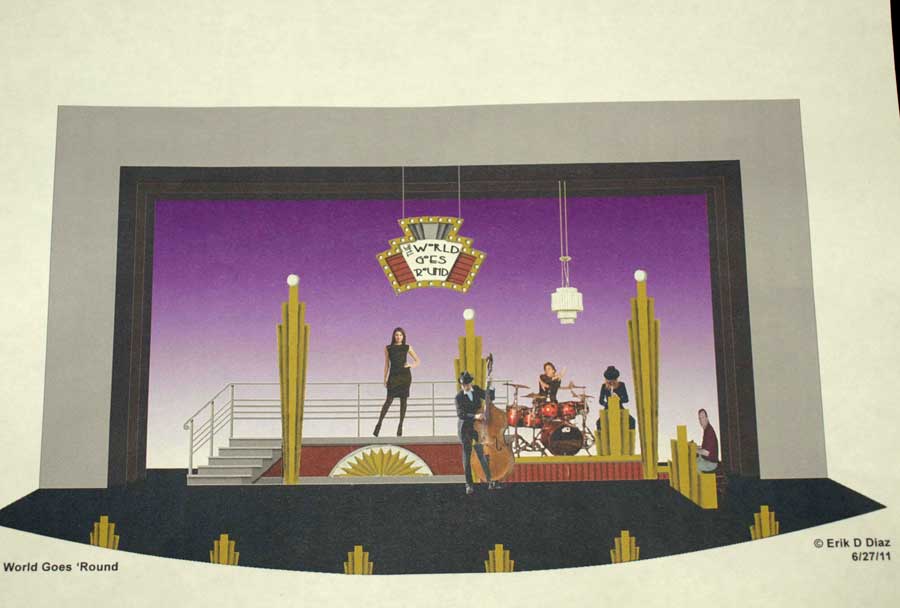 | |||
| The colorful and fun set design by Erik Diaz. |
 |
| Music director Todd C. Gordon helps the cast learn their songs. |
 |
| "My mother bakes well, but you can't compare her, not with Sara Lee." - Kander & Ebb |
Friday, May 06, 2011
Passing Strange Review
By Frank Furnari, New Rep Reviewer
Passing Strange takes us on the journey of a young African-American youth in the 70s as he tries to discover his path in life. The narrator, an older, wiser version of the Youth introduces scenes and adds commentary as well as servers as part of the band. We meet the Youth in South Central LA in 1976 where is mother tries to get him to go to church. He ends up joining the church choir led by the reverend’s flamboyant son. While in the choir he gets to experiment with drugs and gets the idea to go to Europe. The Youth makes the decision to leave home and head first to Amsterdam then to Berlin where he indulges in sex, drugs, and his music. While in Europe his mother longs for his return, but he keeps putting it off, in part because he doesn't want to go back to his home town. At one point near the end of the play, the Youth asks "Why be with people who don't understand you?" the response he gets from one of his fellow artists is "Because they love me." In the end he learns that even when you find your art, you still need your family.
The performance opening night got off to a rocky start with some sound issues and the narrator (Cliff Odie) wasn’t able to grab me in. Odie's acting was solid, but his singing was not up to task. Fortunately, after a little bit of time with the amazingly talented ensemble’s entrance it all changed and I was hooked. Each of the ensemble members had a great voice and were adept at portraying a range of characters. Cheo Bourne masterfully portray's the Youth's journey to find himself and his art. Cheryl D. Singleton portrays Mother with both lovingness and humor – from her occasional lapses into her 'African-American dialect' to her touching phone calls to her son far away. De'Lon Grant, Eve Kagan, Maurice E. Parent, and Kami Rushell Smith all shine in the performances, it is a joy to watch them.
I had tried to watch Passing Strange on PBS when the aired a taping of the Broadway production starring the show's creator Stew. I didn't really care for it and sadly didn't make it through to the end. I'm glad that I got to see New Rep's production of this show as it convinced me that this is a good show once it gets going and a really enjoyable night of theatre.
"Passing Strange": Growing up in Pursuit of "The Real"
By Jana Pollack, New Rep Reviewer
Backed by a rock band, the Narrator (Cliff Odle) starts the show, and we soon meet the central character, simply called "Youth." Cheo Bourne infuses this role with just the right mix of naivete and unbridled youthful passion, and he's a joy to watch. As his mother, Cheryl D. Singleton also hits all of the right notes, and their opening scenes are quite funny. The story moves from the Youth's bedroom in their LA home into the church, where the Youth discovers music. It follows him as he starts a band with his choir friends, but is the only one who wants to stick with it, and as he then leaves home to find what's real: to devote himself to art and see what the world has in store for him.
Bourne and Singleton are joined by a supporting cast of characters who play many roles - first members of the LA church, then members of the artist colonies in Amsterdam and Berlin. Kami Rushell Smith stands out here, bringing passion and presence to all of her pieces. Unfortunately, Eve Kagan consistently overdoes it, which distracts from the rest of the group.
As the Narrator, Odle brings maturity and wisdom to his songs. His voice is not quite up to the task, however, and on songs that he shares with the other members of the musically gifted cast, he sometimes takes away more than he contributes.
Despite these missteps, this is a great show. It is very different, and better for it. Towards the end of the journey, the narrator says: "What do you do when you find yourself living a life that was planned by a teenager?". This elicited a chuckle from the audience, but it gets at one of the central questions of the piece: as we enter adulthood, is there a way to maintain a youthful, artistic sense of possibilities, while still living up to the responsibilities that come with growing up? I certainly hope so; the success of "Passing Strange" may be evidence that we can.
Thursday, May 05, 2011
"Passing Stange": with Flying Colors?
by Jack Craib, New Rep Reviewer
In the last show of its current regular season, New Rep’s version of the musical “Passing Strange”, there is on stage as much talent as has ever graced any off-Tremont stage in recent Boston theater history. New Rep’s production of Stew’s 2008 semi-autobiographical Broadway creation makes a case for being arguably the best possible presentation of the work. The original production in New York lasted just over four months, perhaps primarily due to its sole Tony Award for the best book of the season (not all that impressive, given its only serious competition was the excellent “In the Heights“; the others were the amiably air headed “Xanadu” and the flop “Cry Baby”).
Whereas most often musicals find their biggest challenge in forming a coherent and engaging book, this happens to be this musical’s strong point. Stew’s book and lyrics, for which he alone gets credit, are often witty and sometimes wise, as in the memorable line “my porno films feature fully dressed men making business deals”, or “no one on this stage knows what it‘s like to hustle on the mean streets of South Central (L.A.)”. Some of it is predictable and too often polemic; still, there is more than enough there for coherence and engagement. It must be said that Stew at least tackled some heavyweight issues. Can meaning be found in art? Is life “a mistake that only art can correct”? Do we really spend our “whole adult lives acting on the decisions of a teenager”?
Yet this is a musical, and there’s the rub. The musical score, credited to Stew and Heidi Rodewald, is by and large repetitive, undistinguished and instantly forgettable. Stew himself has his main character, the Narrator (played by Cliff Odle, the only performer who didn’t seem comfortable with his or her part) admit at one point that this would be a good place to include a show tune about a youth (identified only as, uh, Youth, played by the extraordinary Cheo Bourne) planning to travel to Europe; the only hitch is that he admits he can’t write that kind of show tune. This seems obvious by this point in the work, which isn’t necessarily a deal-breaker. Other productions (notably “Spring Awakening” and “In the Heights”) broke new musical ground with their alternative rock and salsa.
Here Stew and Rodewald dish up lukewarm rock, punk, funk and gospel, and, with a few brief exceptions (“Mom Song”, and snippets of “Amsterdam” and “Keys”) they disappoint. Later in the production, Stew has the gall to ridicule the showtuniness of “On the Street Where You Live” (that somewhat memorable little ditty from a musical you may have heard of, “My Fair Lady”). Even Sondheim has been known to indulge in self-deprecating humor about his atypical scores (as in “Merrily We Roll Along” when a character sings that he likes a song you can hum, then references “Some Enchanted Evening”), but he has the musical chops to get away with it. If you’re going to dis an entire musical genre, you’d better be prepared to back up your own claim to fame. On the basis of this score, Stew fails to do so.
Who don’t fail, and in fact do pass with flying colors, are the creative talent on and behind the stage. One standout, Cheryl D. Singleton (as Mother) has an all too brief scene near the end and provides the single moment of heart of the entire evening. All of the performances by the rest of the cast, including De’Lon Grant, Eve Kagan, Maurice Parent, and Kami Rushell Smith, as well as the direction by Kate Warner and choreography by Kelli Edwards, contribute seamlessly to a production that caps off a memorable season of works of transformation.
The only misstep is a musical finale, after a rather abrupt and flat ending, in which the entire cast gets involved in one of the oldest and most overdone theatrical clichés, the forced audience participation game. As they belt out the hypothetical question “Is It All Right?” and their own answer, “Yeah, it’s all right”, one is tempted to paraphrase Stew from elsewhere in the book: “Yes and No. That is, Yo”.
In the last show of its current regular season, New Rep’s version of the musical “Passing Strange”, there is on stage as much talent as has ever graced any off-Tremont stage in recent Boston theater history. New Rep’s production of Stew’s 2008 semi-autobiographical Broadway creation makes a case for being arguably the best possible presentation of the work. The original production in New York lasted just over four months, perhaps primarily due to its sole Tony Award for the best book of the season (not all that impressive, given its only serious competition was the excellent “In the Heights“; the others were the amiably air headed “Xanadu” and the flop “Cry Baby”).
Whereas most often musicals find their biggest challenge in forming a coherent and engaging book, this happens to be this musical’s strong point. Stew’s book and lyrics, for which he alone gets credit, are often witty and sometimes wise, as in the memorable line “my porno films feature fully dressed men making business deals”, or “no one on this stage knows what it‘s like to hustle on the mean streets of South Central (L.A.)”. Some of it is predictable and too often polemic; still, there is more than enough there for coherence and engagement. It must be said that Stew at least tackled some heavyweight issues. Can meaning be found in art? Is life “a mistake that only art can correct”? Do we really spend our “whole adult lives acting on the decisions of a teenager”?
Yet this is a musical, and there’s the rub. The musical score, credited to Stew and Heidi Rodewald, is by and large repetitive, undistinguished and instantly forgettable. Stew himself has his main character, the Narrator (played by Cliff Odle, the only performer who didn’t seem comfortable with his or her part) admit at one point that this would be a good place to include a show tune about a youth (identified only as, uh, Youth, played by the extraordinary Cheo Bourne) planning to travel to Europe; the only hitch is that he admits he can’t write that kind of show tune. This seems obvious by this point in the work, which isn’t necessarily a deal-breaker. Other productions (notably “Spring Awakening” and “In the Heights”) broke new musical ground with their alternative rock and salsa.
Here Stew and Rodewald dish up lukewarm rock, punk, funk and gospel, and, with a few brief exceptions (“Mom Song”, and snippets of “Amsterdam” and “Keys”) they disappoint. Later in the production, Stew has the gall to ridicule the showtuniness of “On the Street Where You Live” (that somewhat memorable little ditty from a musical you may have heard of, “My Fair Lady”). Even Sondheim has been known to indulge in self-deprecating humor about his atypical scores (as in “Merrily We Roll Along” when a character sings that he likes a song you can hum, then references “Some Enchanted Evening”), but he has the musical chops to get away with it. If you’re going to dis an entire musical genre, you’d better be prepared to back up your own claim to fame. On the basis of this score, Stew fails to do so.
Who don’t fail, and in fact do pass with flying colors, are the creative talent on and behind the stage. One standout, Cheryl D. Singleton (as Mother) has an all too brief scene near the end and provides the single moment of heart of the entire evening. All of the performances by the rest of the cast, including De’Lon Grant, Eve Kagan, Maurice Parent, and Kami Rushell Smith, as well as the direction by Kate Warner and choreography by Kelli Edwards, contribute seamlessly to a production that caps off a memorable season of works of transformation.
The only misstep is a musical finale, after a rather abrupt and flat ending, in which the entire cast gets involved in one of the oldest and most overdone theatrical clichés, the forced audience participation game. As they belt out the hypothetical question “Is It All Right?” and their own answer, “Yeah, it’s all right”, one is tempted to paraphrase Stew from elsewhere in the book: “Yes and No. That is, Yo”.
Wednesday, May 04, 2011
"Passing Strange" Not to be Missed
What a trip! The final offering of New Rep’s season is not to be missed. Passing Strange is a tale of a young black man’s pilgrimage of self-discovery, told almost entirely in music. The narrator (Cliff Odele), an older and wiser version of the young hero, introduces and comments minimally on stages in the journey, but the real story is in the music, witty, rocking, poignant and moving – in more ways than one – by the end the audience is dancing in the aisles. Cheo Bourne is affectingly naïve and confused as a young black man growing up in a middleclass home in Los Angeles. He rebels against his mother’s church going (or rather her insistence on his church going) only to discover his first artistic family in the church choir where he is mentored by the choir director. Trapped by his own dependence on his minister father, the closeted gay choir director teaches our hero to smoke weed and implants in him a driving ambition to explore life, his true identity and artistic ambition in Europe.
He will one day have to deal with the mother (Cheryl D. Singleton) who created him, but for now the hero is off to seek a more authentic life and, though he would never admit it, find the substitute family where he can be the self he would like to be. He concedes Paris to his predecessor ex-pats James Baldwin and Josephine Baker, but announces his ambition to conquer the new capital of bohemianism, Amsterdam. With his mind blown by the experience of seeing hashish on a café menu, he is easily seduced by a young woman who offers him her keys in one of the play’s most haunting songs. He finds family in a squalid squat which to its blessed out inhabitants feels like paradise. The singers who populated the LA choir become his Amsterdam housemates, and with them he explores what it means to be an artist whose first creation must be himself. The young man is delighted and bemused by his companions’ combination of sexual and intellectual freedom, exemplified for him by his lover explaining the ramifications of Dutch colonialism with her shirt off.
But paradise cloys, and we’re off again, this time to Berlin where our pilgrim encounters yet another family, this time a radical anti-capitalist heavy metal collective. This family is more demanding, if somewhat silly in their intellectual pretentiousness. When they threaten to evict them, he wins their allegiance with a fake ghetto act – the middleclass black man still can’t be himself, still has to fit into someone else’s stereotypes.
There’s not a single weak spot in this multi-talented cast. The four actors who form the hero’s “family” in each new place, function as a chorus and are particularly striking in their chameleon ability to change vocal and movement styles to fit LA, Amsterdam and Berlin. Each member has moments in the spotlight, though Maurice Parent almost steals the show at a couple of striking moments.
The minimal set mimics a rock concert set-up and we are always conscious of the superb work of the four musicians who provide guitar, drums and keyboard back-up.
Passing Strange is a fitting conclusion to the season (although there is an added summer production to come). The staging and choreography are ingenious and well-executed and the musicians and dancers are definitely up to the task. It’s great fun. Don’t miss it.
~ Johanna Ettin
Subscribe to:
Posts (Atom)