by Jack Craib
New Rep Reviewer
Mark this reviewer down as one of those dazed, or better yet dazzled, audience members fortunate enough to have attended the party of the year. That would be New Rep’s final production of its current season, and Artistic Director Kate Warner‘s final directorial effort of her initial season, namely “Sophie Tucker: The Last of the Red Hot Mamas”. This work, described elsewhere as a musical revue, premiered at Sarasota’s Florida Studio Theater, developed by its Artistic Director Richard Hopkins and Jack Fournier, along with Kathy Halenda, who first created the title role. It has been given a full-throttled treatment in the person of its present titular star, Mary Callahan (and her Musical Director and accompanist, Todd C. Gordon). Many stars can belt; few can do so with such purity of voice and clarity of diction.
This two-act show resembles less a revue than it does a private gathering of the most intimate friends of this self-described forty-something queen of vaudeville and burlesque days. Her repertoire of songs, many of them having earned signature status, is interspersed with her naughty and bawdy punch lines and verbal sparring with Mr. Gordon as her foil. While many of the songs (and jokes, it must be noted) betray their vintage, Callanan’s delivery and timing consistently manage to hit the mark. If Ms. Tucker’s sexual innuendos and double entendres seem a bit tame by today’s more liberal standards, the narrative tying the numbers together not only provides historical perspective for her astounding success, but also reveals her pioneering stage persona to be still relevant today. Any number of past and current stand-up comediennes and female cabaret performers owe at least part of their success to the lady in question.
The party begins with several Tucker standards (the title song, then “A Good Man is Hard to Find”) which lead to others (“There’ll Be Some Changes Made”, “After You’ve Gone”) that frame her brief allusions to her three failed marriages. Her evolution (or more correctly, revolution) led to more powerful and poignant revelatory songs (“Life Begins at Forty”, “Living Alone and I Like It”). Perhaps the most revealing and moving turn is the beautifully-rendered “Yiddishe Momme” wherein the star shares her life-long need for her mother’s love and validation. It was her mother’s conviction that her daughter was strong enough, without demonstrative love, that paradoxically made her the powerhouse she became.
Attention must be paid to the incredibly supportive role of Mr. Gordon at the piano, including his verbal contributions and constant in-character presence; attention must be paid to such a man. Nor should the technical credits be overlooked: the simple scenic design (by Joseph O‘Dea), the lighting design (by John Malinowski) and costume design (for both performers, by Frances Nelson McSherry), all of which add up to a seamless recreation of this bygone era.
By the end of the evening, star and audience have become bosom buddies, so to speak; Ms. Tucker and Ms. Callanan take no prisoners. And that, of course, is precisely as it should be. What a fabulous way to cap the season!

Sunday, June 27, 2010


Wednesday, June 16, 2010
A Red Hot 1st Rehearsal!
Sophie Tucker: The Last of the Red Hot Mama's first rehearsal was yesterday, and it was a great way to kick things off! There is a small gang working on the show and they're already having a lot of fun with the show. The Sophie team is working in the rehearsal hall this week, but they already have some great set pieces and props to work with. Here is a little peak into the Vaudeville world you will experience at the theatre:
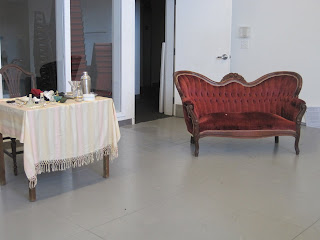


 Mary Callanan (Sophie Tucker) and Todd C. Gordon (Music Director) also did a sing through of the show. They already had us going with the jokes, music, and whole routine!

Here is part of the team (Meghan Fisher, Stage Manager; Kate Warner, Director; Mary Callanan, Sophie Tucker) during the Sophie Tucker meet and greet:
Mary Callanan (Sophie Tucker) and Todd C. Gordon (Music Director) also did a sing through of the show. They already had us going with the jokes, music, and whole routine!Sophie Tucker: The Last of the Red Hot Mamas starts performing next Thursday, June 24th and runs until Sunday, July 11th. Tickets are selling fast, so visit www.newrep.org/sophie_tucker.php to buy your tickets today, or call the Box Office at 617-923-8487.
Thursday, June 10, 2010
We found a book about that RED HOT MAMA!

Todd C. Gordon, musical  director for Sophie Tucker: The Last of the Red Hot Mamas, was browsing through a used bookstore the other day in an attempt to find Sophie Tucker’s out of print autobiography. What he ended up finding was a true gem! The 1945 copy he found of Some of These Days was signed by the one and only Sophie Tucker herself! From the front cover, you can tell it has clearly been flipped through: this spicy mama was definitely someone worth reading about! Director Kate Warner, Todd C. Gordon, and Mary Callanan (our Sophie Tucker) are currently switching off reading this book to find out the inner workings of the Mama from her own point of view.
 director for Sophie Tucker: The Last of the Red Hot Mamas, was browsing through a used bookstore the other day in an attempt to find Sophie Tucker’s out of print autobiography. What he ended up finding was a true gem! The 1945 copy he found of Some of These Days was signed by the one and only Sophie Tucker herself! From the front cover, you can tell it has clearly been flipped through: this spicy mama was definitely someone worth reading about! Director Kate Warner, Todd C. Gordon, and Mary Callanan (our Sophie Tucker) are currently switching off reading this book to find out the inner workings of the Mama from her own point of view.
Rehearsals for Sophie Tucker start on Tuesday, so check back for updates and design concepts for the show next week! In the meantime check out our interview with Mary Callanan and Sophie Tucker Production Notes.
Sophie Tucker: The Last of the Red Hot Mamas runs from June 24 - July 11, 2010. Tickets are on sale now online and at the Box Office - (617) 923-8487.
Thursday, May 06, 2010
Hot(?) Mikado
by Frank Furnari, New Rep Reviewer
Hot Mikado, now open at New Rep, is a 1986 adaptation of Gilbert and Sullivan’s The Mikado (via several other incarnations). Normally, at this point, the reviewer would give you a synopsis of the plot, but this plot is not worth discussing. At the onset we learn that flirting is an offense punishable by beheading, things get crazier from there with lots of things thrown in for seemingly little reason - I guess I should it expect it, this is Gilbert & Sullivan. After a while, this reviewer decided to give up on hoping for a decent plot and decided to focus on the nice music, colorful costumes and set – after that I started to enjoy myself. The show uses some of the melodies of the original, adding various jazz, swing, and gospel elements. The songs were enjoyable and performed well by a talented cast, although there was no “Modern Major General” number to hum on the ride home.
Kate Warner does a good job of assembling a strong, multiethnic cast. This is pointed out humorously when Ko-Ko tries to read Japanese and exclaims “Oh! It’s in Japanese?!” then realizing says, “Oh, we are Japanese!” Calvin Braxton’s Ko-Ko is entertaining to watch, with some funny lines and a great voice, especially in his performance of “Tit-Willow.” Aimee Doherty has become one of Boston’s star performers and does not disappoint, especially during “For He’s Gonna Marry Yum-Yum.” Jamie Howland’s set design is cute, being somewhat evocative of a Japanese garden, but colored in pastels. Speaking of colors, Frances Nelson McSherry’s costumes were full of bright colors all around, even in the men’s suits (of note is Pish-Tush’s purple suit). These are mixed in with some traditional Japanese garb, all of which paint a nice picture.
This brings us back to the plot – if you’re looking for a show with good music, dancing, strong performances, and don’t care much about a good storyline (like certain jukebox musicals that may come to mind), then this is a good show for you, as it appeared that many in the audience enjoyed it opening night. While I certainly enjoyed it more than Huntington’s production of Pirates! last year (yes, I was one of the people who didn’t care for it), I’m starting to get the feeling that Gilbert & Sullivan adaptations may not be for everyone – and not for me.
Wednesday, May 05, 2010
"Hot Mikado": The Punishment Fits the Rhyme
by Jack Craib, New Rep Reviewer
You heard it here first: New Rep’s last production on their current regular schedule, “Hot Mikado”, will be the season’s biggest hit. Based on the red-hot energy emanating from the stage, the incredible performances by its astoundingly multi-talented cast, and the undeniably enthusiastic connection with its opening night audience, it can’t miss.
Unless, like this reviewer, you happen to be a fan of Gilbert and Sullivan fare. As anticipated, given its modernized title, this is not your grandmother’s “Mikado”; sadly, it’s not Sir Arthur Sullivan’s, either. A good deal of lyricist/librettist W.S.Gilbert’s work survives its adaptation (by David H. Bell); the melodies and tempi of composer Sullivan do not. The musical adaptation and arrangement (by Rob Bowman) turns Sullivan’s memorable score into an unmemorable pastiche of swing and jazz (and occasional gospel). Even with these several influences, after a while most of the numbers pretty much numbingly sounded the same.
This might have worked if the adaptors had changed the locale and the cultural milieu of the original in addition to placing it in the 1940‘s. By being neither fish nor fowl, they have diluted rather than extended the satirical bite of its originators, who shrewdly skewered their British contemporaries precisely by utilizing an exotic setting. What remains from the source material, from the setting in the town of Titipu (with a very lovely and functional Japanese garden set by Janie Howland) to the convoluted oriental logic of the plot, jars harshly with the aforementioned musical styles. The eclectic costumes by Frances Nelson McSherry, while creative, add to the cultural confusion; most of the cast look like refugees from “Guys and Dolls” or Disney‘s version of “Dick Tracy”, while several characters retain more traditional Japanse styles. After a while, this misguided missile seemed as unpalatable as a mad scientist's grafting one person’s head onto the body of another. As an adaptation of a well-known classic, it simply doesn’t work.
This is not to disparage the yeoman efforts of the entire cast. While it may be unfair to single out specific performers from such a competent ensemble of professionals, it should be noted that there are some faces that will be happily familiar to local theatergoers. Some are New Rep returnees: It’s really amazing to see Aimee Doherty (from “Speed the Plow”) as Pitti-Sing and Edward M. Barker (of “A Christmas Carol” and “Dessa Rose”) as Pooh-Bah. Jordan Ahnquist, acclaimed for his recent SpeakEasy Stage role in “[title of show]”, as Pish-Tush displays a talent that belies his youth, and Calvin Braxton as Ko-Ko produces a fluidity that must be a product of his years with Cirque du Soleil. One negative note: Lisa Yuen as Katisha, who brings down the house (more than once), is gorgeous, lithe and sexy. In short, she’s the absolute antithesis of Katisha and totally unbelievable when she refers to herself as plain, save for her left shoulder blade. This may have been intentionally ironic, but it backfires. It’s yet another bump in this failed amalgam of material.
Those who are least familiar with “The Mikado” will doubtless find this production a joy. Others, who would include this reviewer, might look upon it as a travesty. There is a reason why the original work has lasted a century and a quarter. The punishment for purists is to endure a musical style that frankly doesn’t fit the rhyme. Not until the second act, when McCaela Donovan as Yum-Yum delivers a straightforwardly traditional (and powerfully poignant) rendition of “The Sun and I”, does the beauty of the original work emerge. And it was extremely telling that perhaps the heartiest audience response of the night was to the equally traditional and compellingly moving version of “Tit-Willow” by Calvin Braxton. Apart from those relatively brief moments, one was left feeling as though he’d just had an oriental dinner: hungry for more Gilbert and Sullivan.
"Hot Mikado" Works Too Hard To Be "Hot"
By Jana Pollack, New Rep Reviewer
An operetta is an acquired taste - a certain style of musical theater that doesn't bear much relation to today's Broadway musicals. However, having been reared on good old Gilbert and Sullivan shows like "Iolanthe" and "the Pirates of Penzance," I was ready to fully enjoy New Rep's "Hot Mikado," a modernized version of the operetta "The Mikado."
Unfortunately, the show did not live up to my expectations. "Hot Mikado" attempts to be a lot of things; it tries to be funny, it tries to be jazzy, it tries to make fun of itself in an interesting way. But it ends up being just an attempt - and, for all that trying, an unsuccessful one.
My issues are both with the show itself and with this particular production. Although "Hot Mikado" has enjoyed relative success since its opening in 1986, I don't find it to have much merit. Gilbert and Sullivan operettas are jokey by nature, and a good amount of laughter at its own expense is inherent in the original script. I'm not sure, then, why it needed updating. If the music were dramatically improved, that would be one reason - however, in this production, jazz riffs feel distinctly out of place, and I left the theater unable to remember a single melody.
The problematic source material is made worse by much over-doing. Songs that should be sung are often screeched, and the dancing is done in a go-for-broke style that doesn't feel smooth. All of the jokes are told with a knowing wink, which occasionally lands but more often annoys.
This isn't to say that there is no talent on display in this production. The screeching is problematic, yes, but I don't doubt that the actors all have lovely voices. The company works to fulfill the overall vision of the show, and that vision is flawed. In fact, the actors are working overtime: it often seemed like they were desperately trying to pull the show together, and I wished that I could feel like their efforts were paying off.
Frances Nelson McSherry's costumes are one aspect that does get it right, with interesting mixtures of Asian conventions and modern styles. There are occasional funny moments: a high point comes towards the end, with Ko-Ko's rendition of "Tit-Willow." And the male lead, Cheo Bourne as Nanki-Poo, has a lovely, smooth voice. Unfortunately, these individual bright spots, as well as a generally talented cast, can't make up for the underlying flaws. "Hot Mikado" is too desperate to prove that it knows it's funny, and the laughter gets lost in the exertion.
Saturday, April 03, 2010
Opus K. Poverman, New rep. reviewer
Opus
I feel like I’ve been really critical about the last couple of New Rep’s productions this season, but I’m afraid that “Opus,” which is currently playing there, is not going to break my crabby streak.
“Opus” has been described as a play that thoughtfully examines the tensions that can exist between love and friendship and a quest for greatness. A more apt description is that “Opus” is a play that explores how willing friends, colleagues and lovers are to throw each other under a bus when it is personally or professionally convenient to do so. I have to admit that a strong performance of the piece could lead to the first construction. However, the New Rep’s tepid production leads to the latter.
The play starts out with Grammy-winning Lazara Quartet seeking a fourth member because it has lost its viola player, Dorian. Dorian, the most talented and creative member of the group, has gone off his meds and has had a nervous breakdown. The only one who knows this is his lover Elliott, the lead violinist, who recently dumped Dorian. The other two members of the Quartet, Alan and Carl, have no idea where Dorian has gone or why. They are mildly concerned by his absence, but this concern is not great enough to stop them from seeking his replacement. They end up offering the position to Grace, a talented young viola player. Although she is flattered by the job offer, the nebbishy Grace is nervous about taking the job; she has heard stories about the group, such as one member threatening to tear another‘s head off. (Puh-leeze. Where did this girl grow up? Disneyworld?) However, Grace overcomes her fears and joins the Quartet, whose members soon show themselves to be as dysfunctional as she had feared. The group holds things together enough to perform at the White House, but things fall apart soon after that. Dorian reappears and challenges the new status quo and the group has to decide which four of them will compose the Lazara Quartet from that point on (this is where the throwing- under- the- bus bit comes in).
The telling of this story was quite slow for the first hour and if there had been an intermission I would have been tempted to leave. However, things picked up in the last twenty minutes or so, during the showdown about the future of the quartet. I’m not sure it was worth waiting for. That said, members of the musical cognoscenti appeared to enjoy the show more than I did. This may be because they could appreciate the audacity of playing Beethoven’s Opus 133 at the presidential inauguration, while I could not. It is certainly true that the two women sitting behind me, who had been members of string quartets, enjoyed the play much more than the rest of the audience. They were often the only ones who laughed at the actors’ lines. This was probably because they understood nuances that passed the rest of us by. When the play was over, they commented on how well the play captured the internecine bickering in string quarters. So, at least the play was realistic. If this is enough for you, then you may enjoy the play. If it is not, you might, like me, find “Opus” dull and uninspiring.
Subscribe to:
Posts (Atom)